
How to Select the Right Centrifugal Process Pump for Industrial Applications
Selecting the right centrifugal process pump is important for maintaining smooth production, reducing energy use, and preventing unexpected equipment failure. A pump that is too small may not provide the required flow and pressure. An oversized pump may consume more power, create excessive vibration, and increase maintenance costs.
Industrial fluids also vary in temperature, viscosity, corrosiveness, solids content, and chemical composition. Therefore, pump selection should not be based only on the inlet and outlet connection size. Engineers must carefully study the complete operating conditions before choosing a pump.
This guide explains the major factors to consider when selecting a centrifugal process pump for industrial applications, including flow rate, head, liquid properties, pump material, impeller type, mechanical seal, temperature, pressure, efficiency, and maintenance requirements.
What Is a Centrifugal Process Pump?
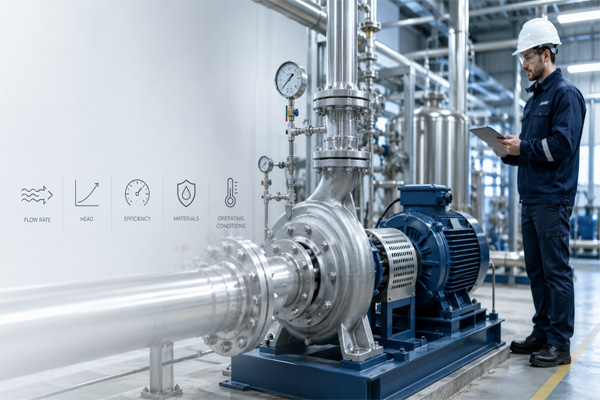
A centrifugal process pump is an industrial pump designed to transfer liquids continuously through a processing system. It uses a rotating impeller to increase the velocity of the liquid. The pump casing then converts this velocity into pressure, allowing the liquid to move through the pipeline.
Unlike ordinary water pumps, process pumps are designed to handle demanding industrial conditions, such as:
- Continuous operation
- High liquid temperatures
- Corrosive chemicals
- Variable flow requirements
- High discharge pressure
- Solvents and hydrocarbons
- Mildly contaminated fluids
- Difficult maintenance environments
Centrifugal process pumps are widely used in chemical plants, pharmaceutical units, petrochemical facilities, food-processing plants, sugar mills, pulp and paper plants, water-treatment systems, and effluent-treatment plants.
Frequently Asked Questions
The required flow rate and Total Dynamic Head are the primary selection factors. However, liquid temperature, viscosity, specific gravity, chemical compatibility, solids content, NPSH, and seal requirements must also be considered.
The required pump head is calculated by adding the static head, required discharge pressure, and friction losses through pipes, bends, valves, filters, heat exchangers, and other equipment.
The Best Efficiency Point is the operating point where the pump provides its highest hydraulic efficiency. Operating close to this point generally improves energy efficiency, reliability, and component life.
NPSH helps determine whether enough suction pressure is available to prevent the liquid from vaporising inside the pump. Insufficient NPSH may cause cavitation, noise, vibration, and impeller damage.
A semi-open impeller may be suitable for liquids containing limited suspended particles. The particle size and solids percentage should still be reviewed by the pump manufacturer.